


Hitting The Right Note
.png?sfvrsn=edc01580_1)
Do we exorcise the ghosts that haunt us, or learn to live with them? This is a metaphorical and literal question asked in August Wilson’s The Piano Lesson. Set in 1936 Pittsburgh, the play focuses on the Charles family, Berniece and her brother Boy Willie, who inherit a family piano carved with the faces and history of their enslaved ancestors. While Boy Willie wants to sell the piano to buy land, Berniece insists it must be preserved as a testament to their family’s legacy. The siblings’ disagreement is complicated by the haunting presence of a ghost, forcing them to reckon with how they confront the past.
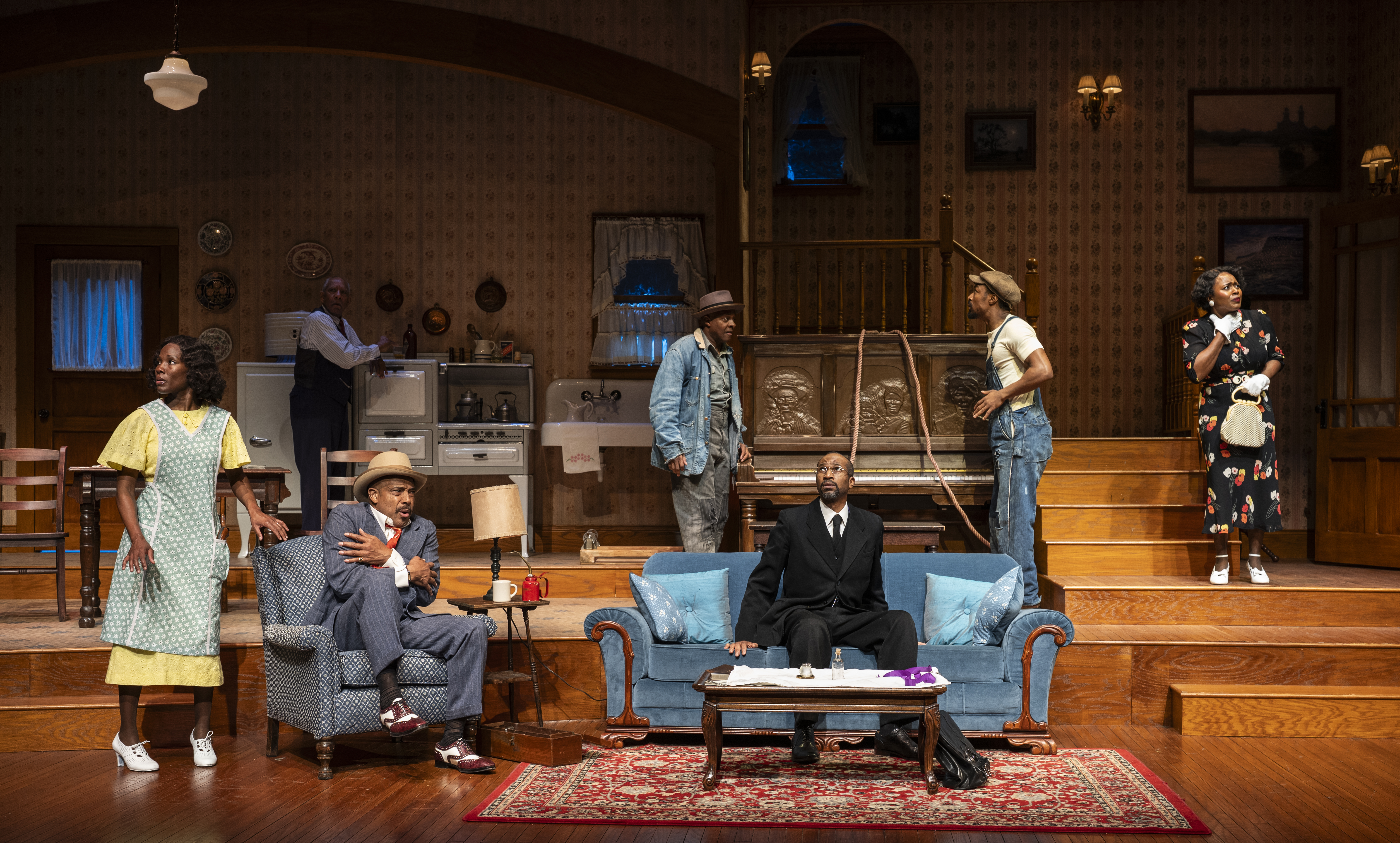
The cast of The Piano Lesson. Photo from co-production with Milwaukee Repertory Theater by Michael Brosilow.
August Wilson often said that his stories came out of the characters and their dialogue. That spark came, in this case, from a single image by celebrated American artist Romare Bearden. Wilson first discovered Bearden’s art in the late 1970s and was instantly captivated. He described the artist’s work as portraying “Black life presented on its own terms, on a grand and epic scale, with all its richness and fullness, in a language that was vibrant and which made attendant to everyday life, ennobled it, affirmed its value, and exalted its presence.”
Two of Bearden’s pieces directly fueled Wilson’s writing: Mill Hand’s Lunch Bucket (1978) inspired Joe Turner’s Come and Gone (1988), and The Piano Lesson (1983) informed this play of the same title. Bearden’s scenes — rooted in childhood memories of the rural South and shaped by his later years in Pittsburgh and Harlem — offered Wilson a visual entry point into the world he was building. “I got the idea from a Bearden painting called The Piano Lesson. It’s of a little girl at the piano with her piano teacher standing over her. And in my mind, I saw Maretha and Berniece.” From that moment of recognition, Wilson began shaping a story not only about a family piano, but about heritage, responsibility, and the cost of moving forward.
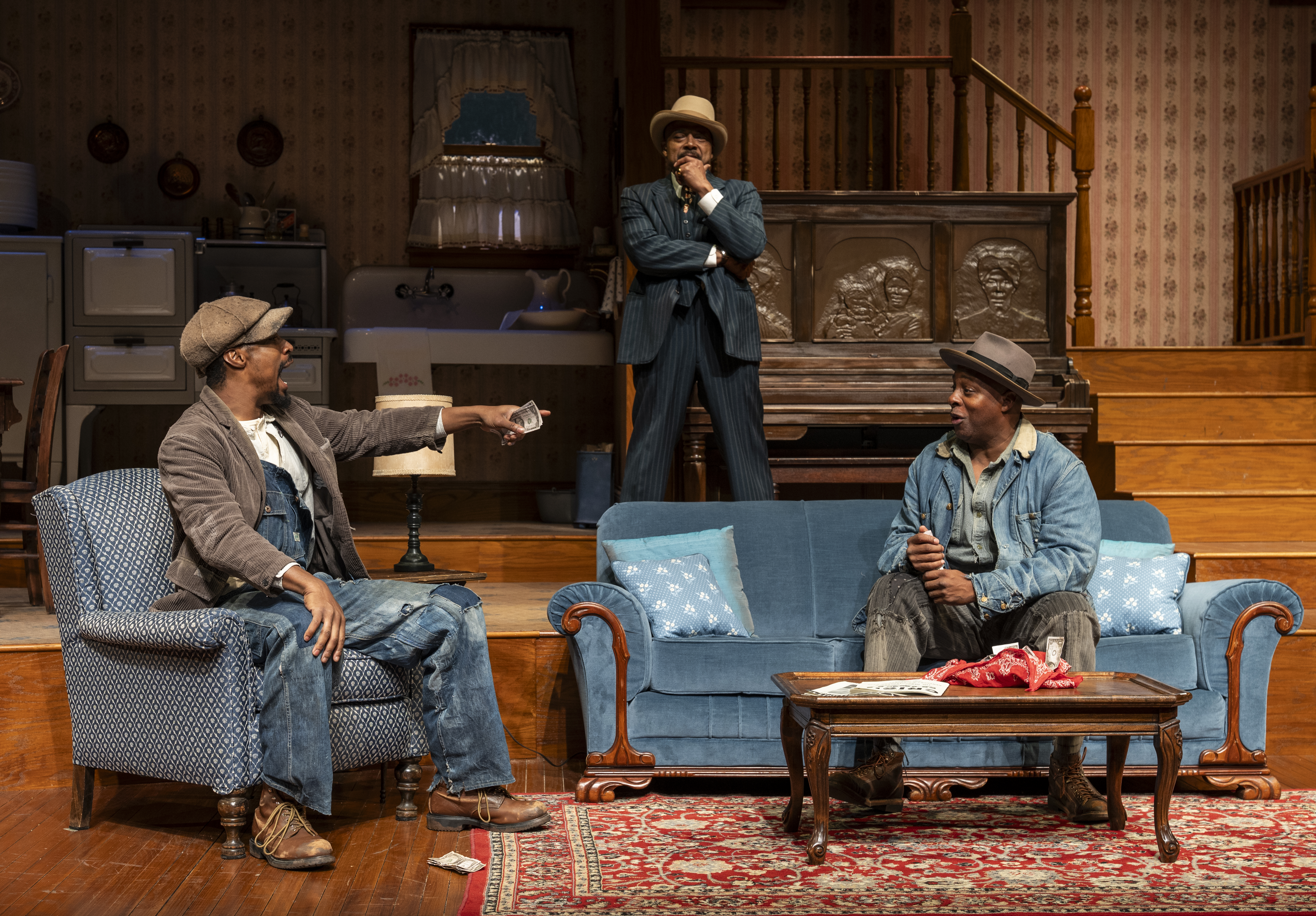
La'Tevin Alexander (Lymon/Fight Captain), Lester Purry (Wining Boy), and James T. Alfred (Boy Willie) in The Piano Lesson. Photo from co-production with Milwaukee Repertory Theater by Michael Brosilow.
This iteration of The Piano Lesson is a co‑production with Milwaukee Rep, where it will rehearse and open before traveling to Cincinnati for the second part of its run. At the helm is director Lou Bellamy, a singular force in American theatre whose work has shaped the national conversation around Black storytelling onstage. An OBIE Award– winning director and accomplished actor, Bellamy founded Penumbra Theatre Company in Saint Paul, Minnesota, and guided it for nearly 40 years, cultivating a home for artists exploring the breadth and depth of the African American experience. Under his leadership, Penumbra became the cradle of several landmark works, including August Wilson’s first professional production, and went on to produce more of Wilson’s plays than any other theatre in the country. His artistry brings a deep, lived understanding of Wilson’s world — its lyricism, its weight, and its humanity — to this new staging.
In addition to the performance itself, audiences will be invited to experience a broader landscape of Black artistry throughout the Playhouse lobby. The Robert O’Neal Multicultural Arts Center (ROMAC) will showcase new works by local teenage artists that were created in response to the legacy and visual language of Romare Bearden. Founded in 2019 to celebrate African and African American arts, history, and culture, ROMAC has become a vital platform for emerging voices whose perspectives deepen the region’s creative ecosystem. Their work is vibrant, searching, and in conversation with the past, creating a living dialogue between generations of artists. As these contemporary pieces engage with Bearden’s influence, they echo the very questions at the heart of The Piano Lesson: how we reconcile where we come from with where we are going, and how art continues to carry our stories forward.