


Gender, Power, and People Behaving Badly: Inside Theresa Rebeck's World
Theatregoers anticipate certain hallmarks of Theresa Rebeck plays. Razor-sharp dialogue. Epic speeches, often from people spiraling under pressure. Character-driven stories exposing the contradictions inherent to human behavior, usually with humorous results.
“I can’t start until I know who the characters are,” Rebeck said in an interview prefacing the publication of two recent scripts. “For me, the rule is action rises out of character. Conflict rises out of action. Story rises out of conflict. If you have all of those things, and if they’re honest, you have a play.”
Rebeck’s work possesses a signature style but attempts to box it into a specific category would be futile. Read enough about Rebeck and you’ll find one description repeated more than any other: prolific. She’s the most Broadway-produced female dramatist of our time and a 2004 Pulitzer Prize finalist for Omnium Gatherum. In addition to more than 40 full-length and one-act plays, the Cincinnati native has authored three novels and dozens of films and television shows, notably NYPD Blue and Smash. That productivity yields considerable variety.
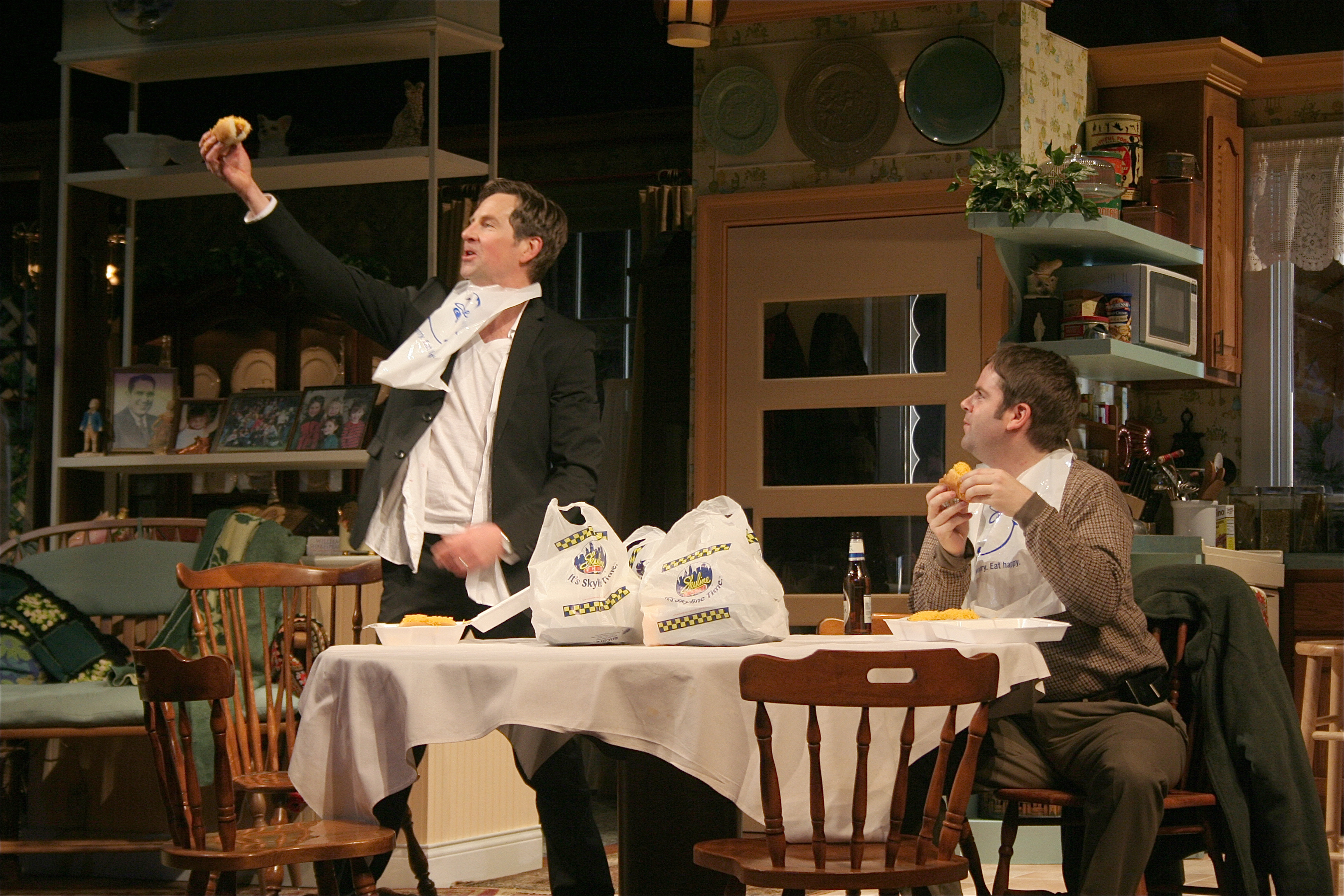
Stephen Barker Turner and Haynes Thigpen in Dead Accounts. Photo by Sandy Underwood.
Spike Heels and Bad Dates, the latter seen in 2005 and 2016 Cincinnati Playhouse productions, put Rebeck on the theatrical map. The first is a Pygmalion-infused examination of control, class, and sexual harassment. The second offers a hilarious send-up of modern dating through the eyes of a single mom inadvertently entangled with the Romanian mob. Both earned Rebeck a reputation for writing “feminist” plays, a term some critics wielded upon scripts daring to feature strong, multidimensional female characters.
“I never had an agenda,” Rebeck said in an industry keynote. “I just wanted to write plays that told the truth. Some of those plays told the truth about what it is like to live on this planet as a woman. Why would that be off the table?”
Other works share truths about the business of entertainment from her insider’s perspective. The Family of Mann skewers the toxic, ego-fueled writers’ room of a television sitcom. The Understudy (produced at the Playhouse in 2010) satirizes commercial theatre’s reliance on celebrity casting. On the nonfiction front, Free Fire Zone is a must-read for anyone wishing to understand the power dynamics writers encounter across stage, TV, and film.
Then there are plays that explore what The New York Times called Rebeck’s “acute interest in bad behavior.” The three collectors in Mauritius, which marked her 2007 Broadway debut, betray each other in hopes of snagging a pair of very rare stamps. The formidable novelist in Seminar savors shredding the aspirations of four young writers in his private workshop. And in Dead Accounts, commissioned by and premiered at the Playhouse in 2012 before a Broadway production later that year, the prodigal son craving Cincinnati comforts is revealed to be running from both a failed marriage and his orchestration of a $27 million embezzlement scheme.
While themes vary greatly, the thread connecting much of Rebeck’s work is comedy. “I honestly believe that the act of finding humor in real despair is both courageous and life-affirming,” Rebeck told Bomb magazine. “Some people think comedy is a less-serious form than drama. I would say, ‘Far from it.’”
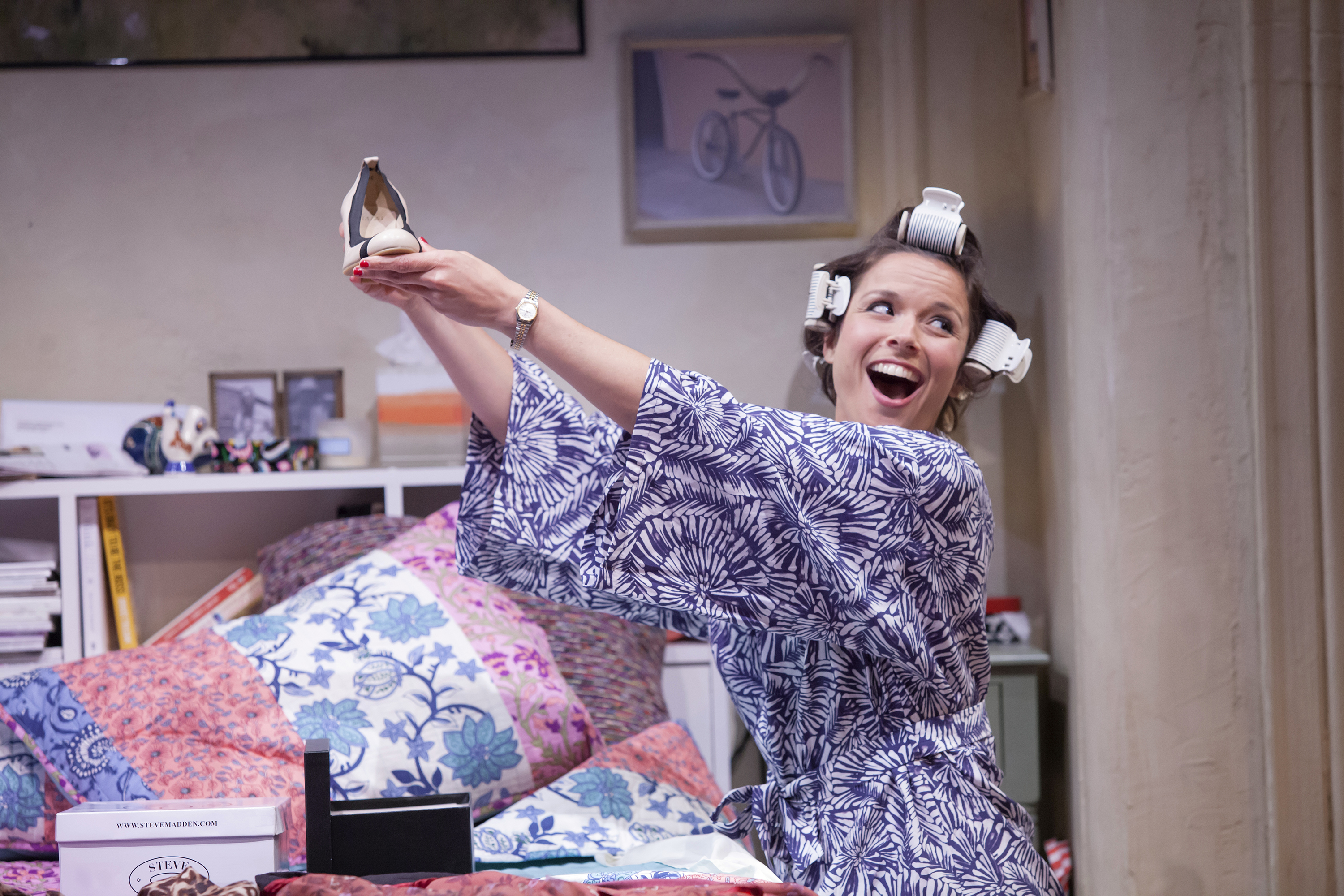
Vivia Font in Bad Dates (2016). Photo by Mikki Schaffner.
Comedy also grounds Talk, Rebeck’s latest play and the cornerstone of the Playhouse’s inaugural Made in Cincy: New Works Festival. Talk represents another homecoming for Rebeck, who often discusses the Playhouse’s role in introducing her to theatre.
“When I was in grade school — All Saints — they had student matinees,” Rebeck told American Theatre’s “The Subtext” podcast. “Three times a year, you gave them your permission slip and $5 bucks, and they put everybody on a bus, and you went down to Cincinnati Playhouse in the Park. I fell hard for theatre before I knew who I was. I thought playwrights were gods.”
Today, it’s Rebeck inspiring the next generation of storytellers and championing theatre’s cultural relevance. “I’m one of those people who believes theatre is a lesson in empathy,” she told TDF Stages. “We all come together, and we share a story with these actors on the stage. We learn to feel for each other, and that is a good thing. That’s the power of theatre.”