


Developing Story
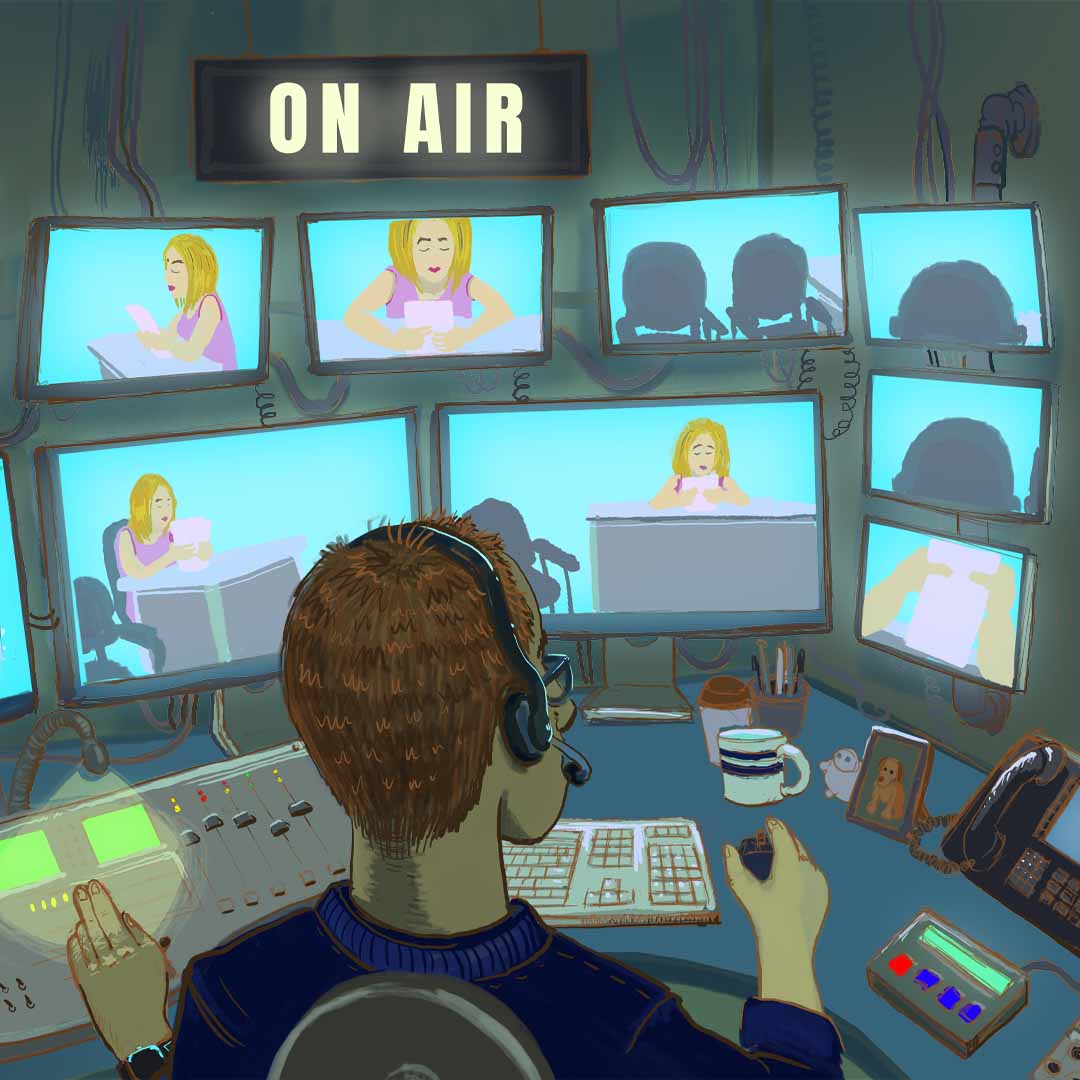
It’s no secret that the Cincinnati Playhouse in the Park has long been committed to uplifting and championing new play development. But if the launch of the Made in Cincy: New Works Festival wasn't enough to make the case for our dedication to new plays, then our commissioning initiatives put it beyond all doubt. Of the 90 world premieres produced since the Playhouse’s founding, over a quarter of those plays have been commissions. A commission funds and supports a playwright and their play through multiple drafts, workshops, and table reads with the aim of eventual production on one of our stages. It is, in effect, a years-long bet on a person rather than a finished script: the Playhouse commits its resources before it knows what the play will become, trusting the process to get there. This season, we’re proud to produce our next commissioned project, Talk by acclaimed playwright and Cincinnati native Theresa Rebeck.
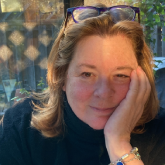
Playwright, Theresa Rebeck
Rebeck’s Dead Accounts was a Playhouse commission that went on to Broadway in 2012, and her play Bad Dates was a hit with Cincinnati audiences in both 2005 and 2016. Her return, then, feels especially fitting — she is an artist with a meaningful history here and a track record of engaging Playhouse audiences. And in Talk, that relationship continues with a story that feels both timely and unmistakably Rebeck.
Talk is about a cable news talk show host who is hosting a live show at the urging of her producer and studio executives to boost ratings. When she insists that one of her guests, a Nobel Prize-winning economist, is boring, she enlists her producer to find a last-minute replacement to speak on the show’s topic, a global minimum wage. The live show descends into chaos as the surprise replacement sparks rising arguments from the other panelists on the show. The aggressive banter builds into an explosive climax that Theresa Rebeck — Playwright leaves the characters, and the audience, reeling.
Osborn Family Producing Artistic Director Blake Robison is keenly aware of the importance of commissioning new works. In 2018, he commented to the Cincinnati Enquirer, “When you have the resources to invest in new playwrights and new stories — and we do — then doing productions like this becomes your responsibility to the art form.” When he sets his sights on a prospective commission, he does so in a variety of ways. Sometimes he’ll approach a playwright with a vague idea about themes and topics. Sometimes he’ll leave the door wide open for creative possibilities. Back in 2021, he reconnected with Rebeck, and the two engaged in creative conversations about what stories she’d be interested in telling next.
Originally, this commission was intended to be an adaptation of Nathaniel Hawthorne’s The Scarlet Letter. “I was having coffee with Theresa in New York, and I said, ‘Wouldn’t it be great to do something that fits in with high schools and their reading lists?’” said Robison, adding that they discussed a variety of books that most students read in school before landing on The Scarlet Letter. “It’s such a fascinating morality tale, and it’s a good time to readdress it. There hasn’t been a stage version of it for nearly 20 years, so that’s very exciting to me.”
That plan didn't survive contact with the writing process itself. Rebeck was pulled toward a different story, and Robison didn't try to talk her out of it. This is, in a sense, the whole premise of the commission: you back the writer, not the outcome. If the work wanders in a direction nobody anticipated, that's not a failure of planning — it's the plan working as intended.
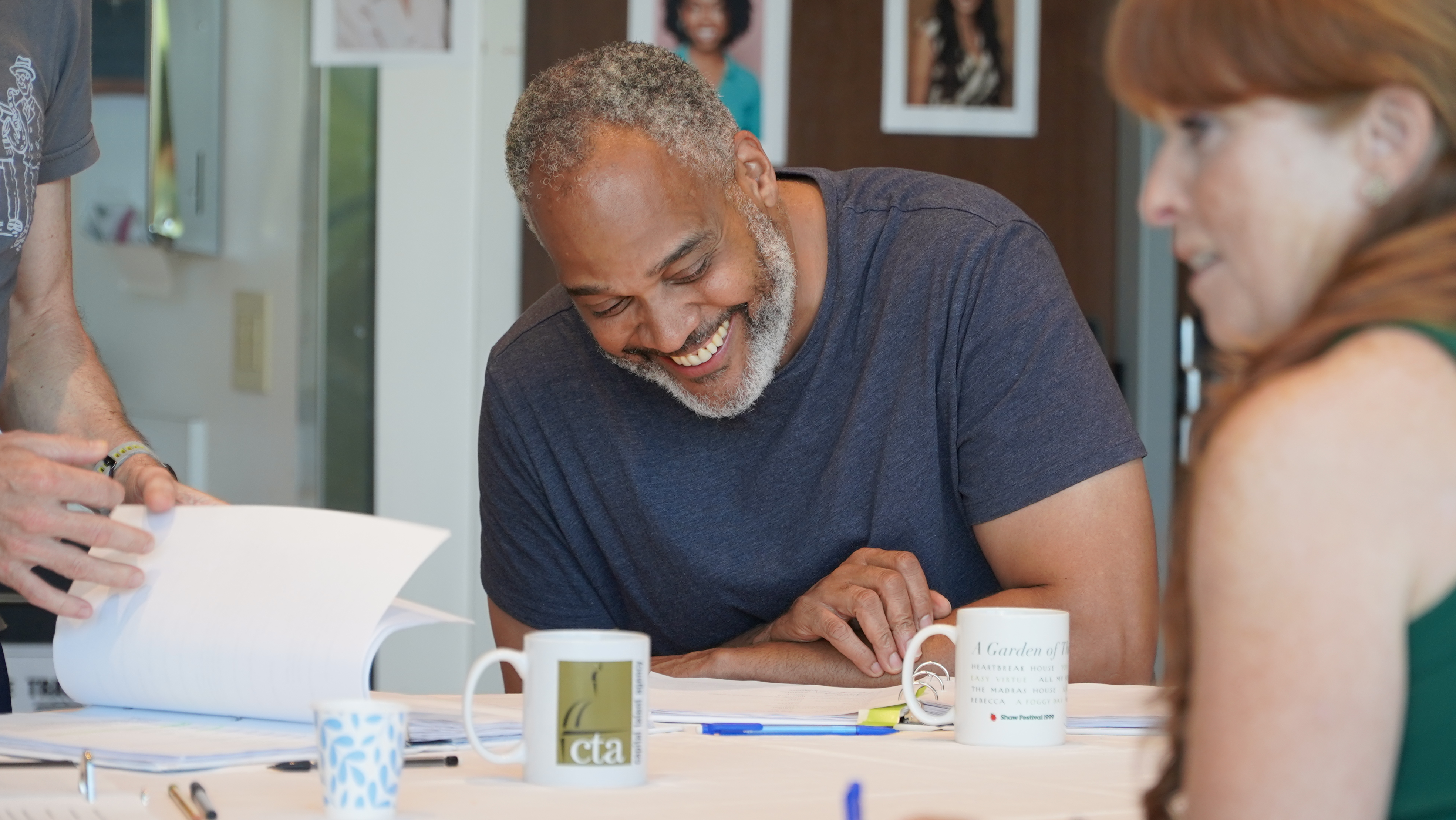
Victor Williams (Malcolm) in Rehearsal for Talk
That spirit of following the work wherever it wants to go led Rebeck away from Hawthorne and into the chaotic world of cable news. Drawing on her own experiences writing for television, she set out to satirize the increasingly performative nature of public discourse, where outrage often carries more value than expertise and entertainment can eclipse conversation. The first draft was already funny, but its central character pushed so hard that it was difficult to stay with her. Early conversations about the play focused on making the main character, Brenda, less abrasive without sanding off the qualities that make her such a force. Rebeck returned with another draft that found that balance. Soon afterward, the script was workshopped in New York.
A workshop isn't a rehearsal, exactly. There are no costumes or scenery, and actors spend most of the week seated around a table with scripts in hand. This workshop brought together Rebeck, Robison, a director, a dramaturg, a stage manager, and a remarkable cast. For a week, the room ran on caffeine and close listening, everyone tracking the same question from a different seat at the table. Some of the actors from that room will also appear in the Cincinnati production, carrying what they discovered into the next stage of the play's life.
From the outside, a workshop might look like a simple table read. From the inside, it's more like watching a play rewrite itself in real time. “It’s important to me for the play to feel contemporary. Like it’s responding to the present moment, right now,” Rebeck said before entering the workshop process. This became a lens through which feedback was given. The actors read a scene aloud. Someone stops to ask a question. Why does this character say this? Does this joke land? Is there a clearer way to phrase that thought? The actors weigh in. The director offers an observation. Robison chimes in. The dramaturg asks questions to help clarify the story. Rebeck listens, pushes back when she disagrees, laughs when something unexpected emerges, and quietly starts typing. Every adjustment is recorded as it happens. By the end of the week, the play has become something new.
This new draft is the one that arrived in Cincinnati. It's the version the artistic team used to begin assembling the artists who will ultimately bring it to life. Even then, though, the play isn't finished.
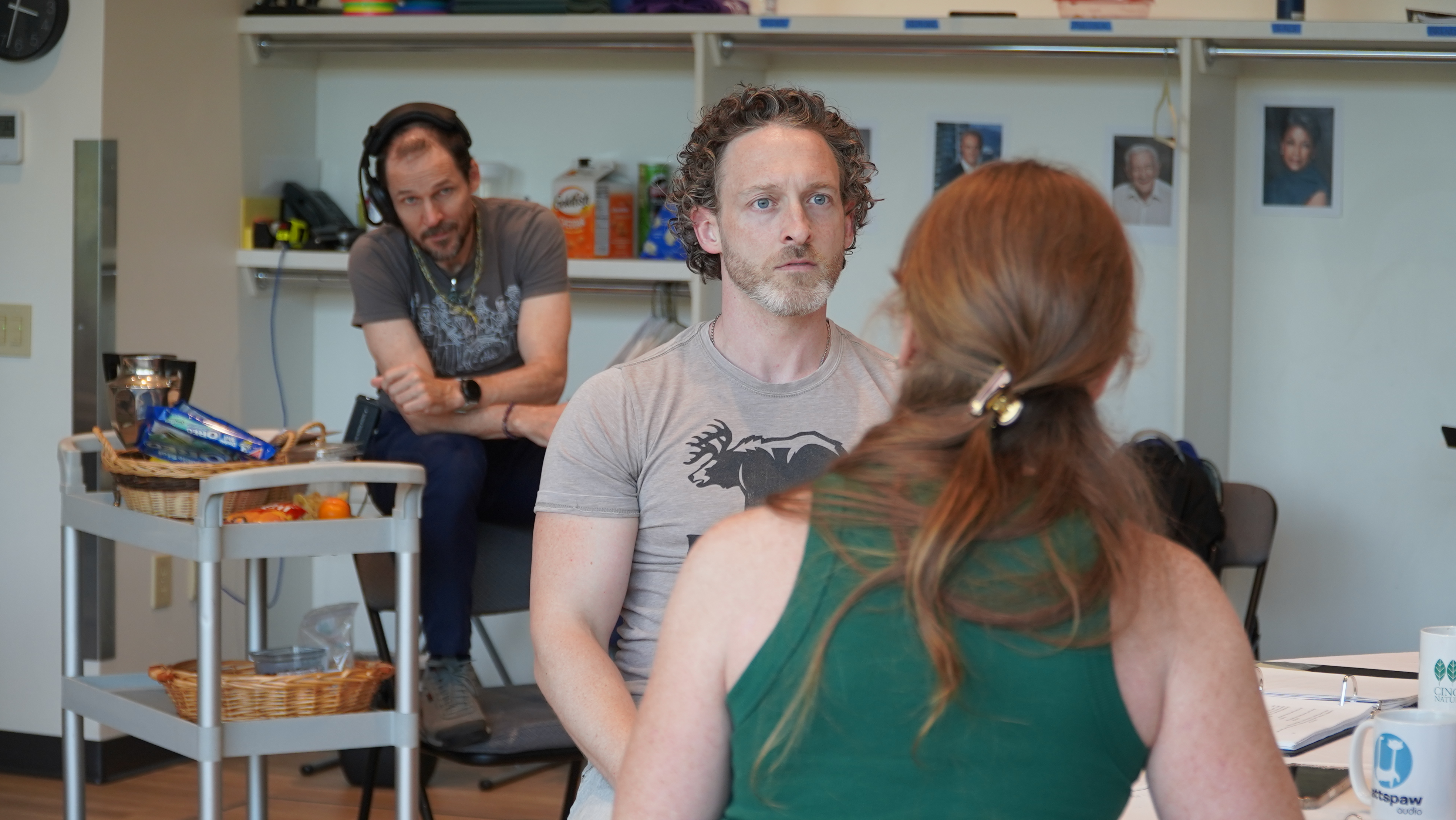
Joey Collins (Serge), Luigi Sottile (Jonathan), Maxine Linehan (Simone) in Rehearsal for Talk
In the months leading up to rehearsal, the director and design team met to figure out what the play will look and sound like. The dramaturg and director spent hours with the script together, asking questions before actors and the playwright step into the room. These sorts of questions are geared towards deepening understanding of how the play works. What kind of relationship does Brenda have with the audience? Is she selling ideas, or selling herself? When is she speaking from conviction, and when is she simply repeating talking points? How does the play explore capitalism not just as an economic system but as a set of values that shapes the way Brenda moves through the world? Beneath all of the comedy, where are the moments of genuine truth?
Not every question needs an answer before rehearsal begins. In fact, many of them are better answered by actors standing on their feet than by people sitting around a conference table. Those conversations become the next round of discoveries. The actors will reveal new possibilities. Rebeck will continue revising. Characters will become fuller, motivations clearer, rhythms sharper. By the start of technical rehearsals, the script will finally lock into place so designers can build the technical world around it.
And even then, in some ways, the play is still becoming itself.
That's the remarkable thing about a commission. Audiences often think they're coming to opening night to see a finished product. In reality, they're seeing the latest chapter in a years-long conversation between playwright, artists, and audience. Every draft, every workshop, every rehearsal asks the same question: "Can this story become clearer, funnier, richer, more human?"
With Talk, Cincinnati audiences won't just be seeing Theresa Rebeck's newest play. They'll be seeing the result of hundreds of conversations, countless questions, and years of collaborative curiosity — exactly the kind of artistic journey a commission is designed to make possible.